

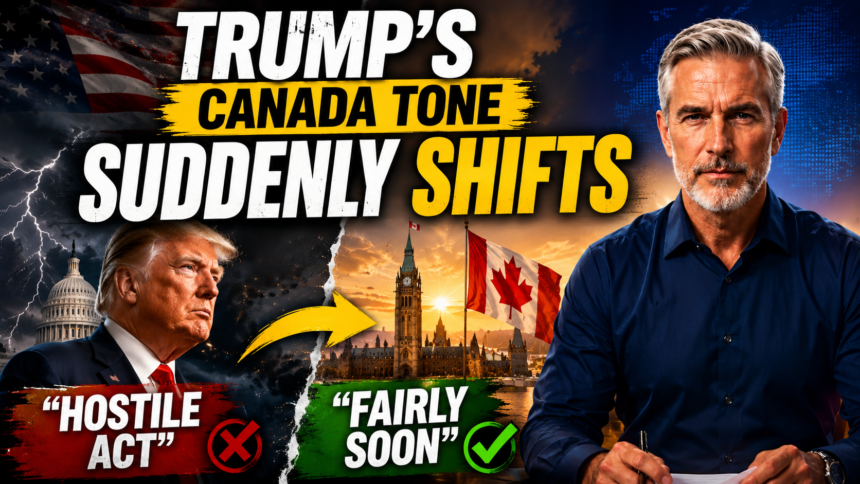
Donald Trump’s language toward Canada changed dramatically within just a few days — from calling a possible Canadian move toward Europe a “hostile act” to saying a deal with Canada could happen “fairly soon.” But what explains the sudden shift?
This video examines the pattern behind the latest Canada–U.S. trade tensions, including the breakdown of previous negotiations, new tariffs, Canada’s retaliatory measures, and the possibility that the uncertainty itself may be part of the negotiating strategy.
We also look at the argument raised by Council on Foreign Relations analyst James Lindsay, who has questioned whether some of the confrontation could be part of negotiation theater. The video explores the “pencil, not ink” metaphor for Canada–U.S. agreements and why repeated changes in trade policy can create uncertainty for businesses, workers, consumers, and banks.
Another major part of the story is Canada’s relationship with Europe. With Europe offering Canada another potential strategic channel, Ottawa now has to balance its relationship with Washington while continuing to explore alternative partnerships.
The bigger question is whether “fairly soon” actually becomes a detailed and durable agreement — or whether another reversal is waiting around the corner.
This documentary-style analysis looks at:
• Trump’s changing language toward Canada
• The “hostile act” and “fairly soon” statements
• Canada–U.S. tariff escalation
• The possibility of negotiation theater
• Why trade agreements may remain provisional
• Canada’s efforts to diversify beyond the U.S. economy
• Canada’s growing European relationship
• The impact of uncertainty on workers and businesses
• Why investors are watching Canada’s reliability
• What could determine whether the latest optimism becomes lasting policy
- Council on Foreign Relations (CFR) — James Lindsay’s analysis regarding the Canada-U.S. confrontation and the possibility of negotiation theater.
- CBC News / CBC analysis — tariff changes and the interpretation that selective tariff adjustments leave room for negotiation.
- Unifor — Daniel Cloutier’s comments regarding workers and the economic impact of the trade confrontation.
- Mark Carney / Government of Canada — statements concerning Canada’s reputation as a reliable international economic partner.
- European Union — formal offer concerning Canada’s potential status as the EU’s first associate member.
- Canada–U.S. trade developments — tariff announcements, negotiations, retaliatory measures and their economic effects as described throughout the script.
- Canadian banking sector — discussion of direct tariff exposure versus broader economic effects through consumer and business lending.