





Washington, DC — US President Donald Trump and congressional Republicans face a challenging political environment ahead of the November 3, 2026, midterm elections, as national polling averages show Democrats holding a significant lead in the race for Congress.
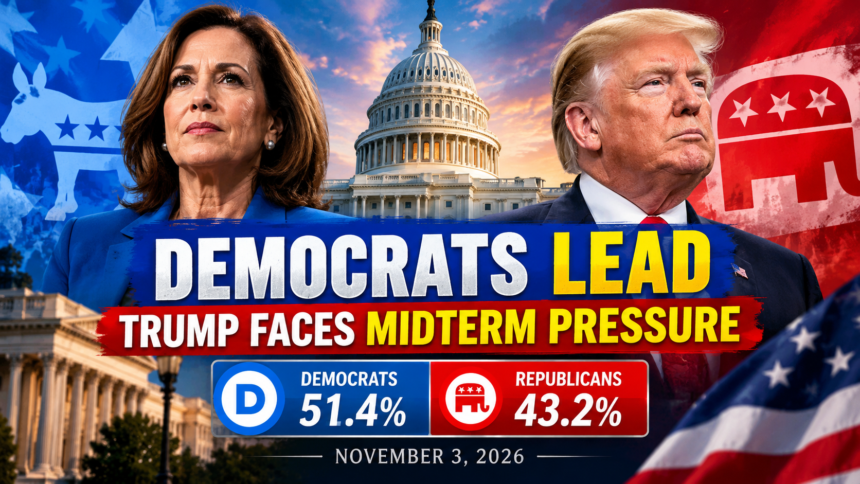
According to the RealClearPolling average covering October 8–26, Democrats received 51.4% support, compared with 43.2% for Republicans. This represents an 8.2-percentage-point advantage for Democrats in the national generic congressional ballot, a measure of voters’ overall party preference for congressional elections.
The figures suggest that Democrats have an opportunity to make significant gains in Congress. However, national polling averages do not guarantee a particular election outcome, as individual House and Senate races depend on local political conditions, candidates, turnout and the distribution of votes across states and congressional districts.
Why Are Democrats Leading in the Polls?
The polling advantage places additional pressure on Republicans as they seek to maintain their congressional majorities. Voters’ concerns about the economy, the cost of living and the direction of the country could influence how Americans vote.
A Reuters/Ipsos poll completed on October 26 also found Democrats ahead on the generic congressional ballot. Among likely voters, Democrats led Republicans by 53% to 44%. The findings point to a competitive political environment for the Republican Party ahead of Election Day.
However, polling results can change, and different surveys may produce different estimates depending on their methodology, sample and the voters surveyed.
What Is at Stake for Donald Trump?
The midterm elections will help determine the balance of power in the US Congress during the remainder of Trump’s presidential term.
If Democrats gain control of one or both chambers, they could have greater influence over legislation, government spending, investigations and congressional oversight of the administration.
A change in congressional control could also make it more difficult for Trump to advance his legislative priorities. If Republicans retain their majorities, the administration could have a stronger opportunity to pursue its agenda through Congress.
The election results will therefore matter not only for individual candidates but also for the future direction of US domestic policy.
Why National Polls Do Not Guarantee Election Results
Although Democrats lead in the national polling average, the United States does not elect Congress through a single nationwide popular vote.
House seats are decided in individual congressional districts, while Senate races take place in specific states. Consequently, a party can lead nationally without winning enough individual contests to secure control of Congress.
Factors such as candidate quality, campaign spending, voter turnout and the competitiveness of individual districts can all affect the final outcome.
For this reason, the 51.4% to 43.2% figures should be understood as a snapshot of national voter preferences rather than a definitive prediction of which party will win the election.
When Are the 2026 US Midterm Elections?
The 2026 US midterm elections are scheduled for Tuesday, November 3. Voters will choose members of the House of Representatives and a portion of the Senate, alongside state and local officials in many jurisdictions.
With Election Day approaching, both parties are seeking to persuade undecided voters and encourage supporters to participate.
Conclusion
The latest RealClearPolling average shows Democrats leading Republicans by 8.2 percentage points in the national congressional ballot, highlighting a potential challenge for Trump’s party ahead of the 2026 midterm elections.
The central question is whether Democrats can translate their national polling advantage into enough victories in individual congressional races to change the balance of power in Washington.
The final result will depend on voters across the country, making the November 3 election an important test of the political climate during Trump’s presidency.
RealClearPolling:2026 Generic Congressional Vote Polling Average — National polling average showing Democrats at 51.4% and Republicans at 43.2%.Reuters:Trump Approval and Midterm Election Polling — Recent polling on Trump’s approval rating and the congressional ballot.CNN Poll of Polls:Generic Midterm Ballot Polling — A separate polling average tracking Democratic and Republican support.